Chinat · July 14, 2026
The Future Unfolds: My Notes from Bank of Singapore's CIO Summit 2026
Last Monday I spent the day at Bank of Singapore's first Chief Investment Summit in Hong Kong. Thank you, Canis, for the invitation. I walked in as a builder who spends most of his time at hackathons, and walked out with a notebook full of things I'm still chewing on.
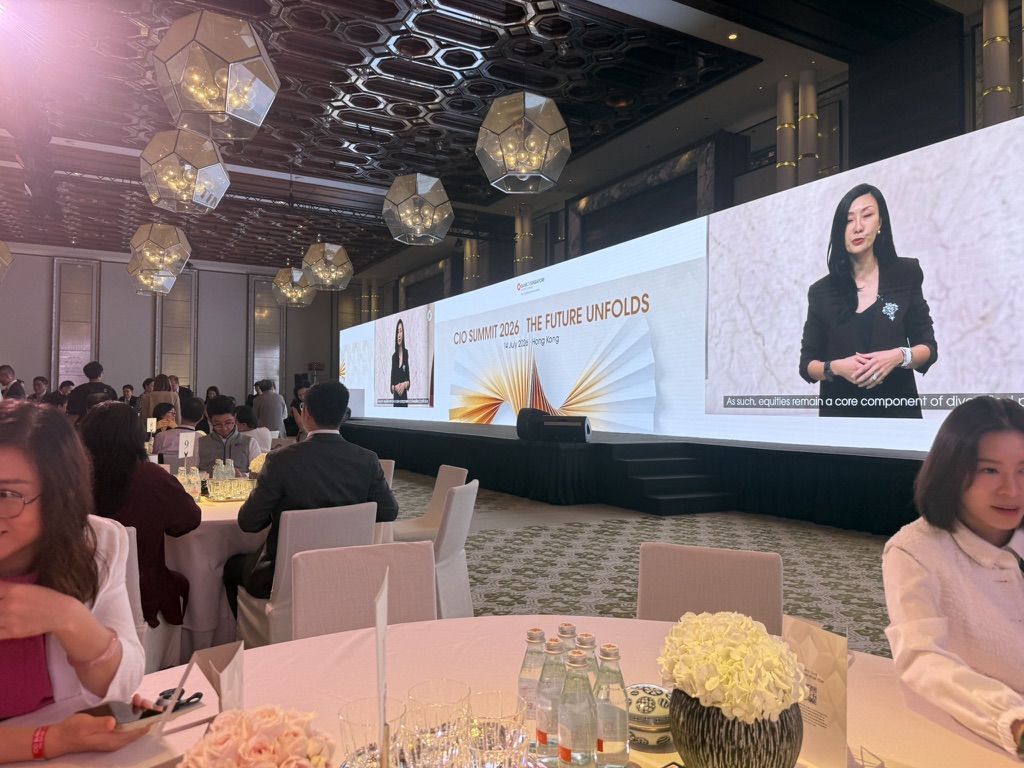
The theme was "The Future Unfolds." Here's my honest recap of what the CIO team, Howard Marks, and the closing panel actually said.
The first half, scored
The CIO team opened by grading their own calls, which I respected. First half of 2026: equities up about 12%, alternatives up 3.4%, fixed income flat. The two forces that shaped everything were the Middle East energy shock, which pushed up oil, inflation, and bond yields, and an AI rally that was narrow but powerful, especially in Korea and Taiwan through semiconductors and memory.
What they got right: resilient growth, no AI bubble, preferring Asia ex-Japan. What they missed: they expected a weaker dollar and lower oil. Both went the other way.
Five supertrends
Their framework for the next several years came down to five structural themes:
- Choke points. Control over critical resources and supply chains is now a permanent feature of markets, not an episode. Resilience is replacing efficiency as the organizing principle of global trade.
- The whole portfolio. Since 2022, stock-bond correlation has turned positive, so the classic 60/40 diversification quietly stopped working. On top of that, over 80% of global equity gains this year came from AI tech stocks. Their answer: alternatives, private markets, hedge funds, infrastructure.
- China, transformed. The property drag is real but showing early signs of stabilizing, and the growth engine is shifting to advanced manufacturing, EVs, automation, and AI. China now holds over 60% of global AI patents, and its high-tech exports are up more than 40% this year.
- AI as a long revolution. Their four-phase map: compute (the GPU ecosystem, up roughly 7x), infrastructure buildout, agentic AI and commercialization (memory and storage as the bottleneck, up roughly 16x), and finally a productivity leap through physical AI: robots, autonomous driving, edge devices, power management, sensors, even space infrastructure. Their advice was to position for phase four early.
- The longevity economy. By 2050, one in five people will be over 60, and spending by that group is projected to grow from $35 trillion to $96 trillion. Healthcare, financial services, robotics, senior housing.
On positioning: overweight equities, expressed mainly through the US, on the argument that this rally is earnings-led rather than multiple-led, which is the opposite of 1995 to 1999. In Asia ex-Japan they prefer Hong Kong, China, and Singapore. Fixed income underweight with neutral duration, favoring investment grade and emerging-market corporates. Alternatives to fix the concentration problem.
Howard Marks on temperature-taking
The session I'd been most excited about lived up to it. A few lines I wrote down:
"The worst loans are made in the best of times." His read is that capital has been on the easy side for years, some recent credit stress has restored discipline, but the market has not fully repriced risk. He is watching private credit closely, not because it's broken but because it has never been through a real storm. The differentiation between strong and weak managers only shows up when conditions turn.
He was refreshingly allergic to forecasting. No Fed predictions, no macro models, just: know where you are in the cycle, and accept you can't know when it turns. On AI he saw optimism, not necessarily euphoria, with a caveat that stuck with me: AI's impact on efficiency may be enormous while its impact on profitability stays unpredictable.
His summary of the whole game: own companies that can grow, lend to companies that can pay you back. Everything else is noise.
The closing panel: fewer illusions, more stability
The final dialogue on US-China relations reframed something for me. The panel's view was that the relationship hasn't warmed; it has matured. Not more trust, fewer illusions. America no longer believes engagement will change China, and China no longer believes integration will make America accept its rise. Strangely, that clarity is stabilizing. Both sides now treat competition as permanent and unmanaged escalation as unaffordable.
The complication is that issues like chips now cut across trade, security, and industrial policy at once, so nothing gets resolved at the working level anymore. Everything escalates to the very top, which means clearer boundaries but fewer shock absorbers.
On China's economy, the panel converged on a U-shaped recovery rather than a V. The line of the day: good stimulus doesn't reverse the gear shift, it keeps the engine from stalling. The real constraint is confidence, described as three hesitations feeding each other: households hesitant to spend, companies hesitant to invest, investors hesitant to believe the rebound. One panelist made a strong case that the renminbi has entered an appreciation cycle and could strengthen around 5% a year without hurting competitiveness.
Two more ideas worth keeping. A Singaporean panelist argued for the "strategic middle": as the US and China narratives harden, the world increasingly depends on capable third parties with capital, institutions, and infrastructure to keep the system running. And on choke points, the sharpest observation was that supply-chain security is about to stop being a China issue and become everyone's issue, which implies a global wave of resilience-driven investment in manufacturing, energy, and critical minerals.
What stayed with me
For the AI market specifically, the summit's message was consistent across every session: the rally is real because the earnings are real, the bottlenecks are physical (memory, power, infrastructure), and the next leg belongs to applications and physical AI rather than model-makers alone. As someone who spends weekends watching builders ship AI products, that's the part I'd underline twice.
The keynote by Dr. Tao Dong deserves its own writeup, and I gave it one: SpaceX, the East India Company, and Hong Kong's Next Chapter.
None of this is investment advice. I was the guy in the room taking notes like it was a lecture I didn't want to end.
Comments
Loading…