Chinat · July 14, 2026
SpaceX, the East India Company, and Hong Kong's Next Chapter
I spend most of my time in rooms full of builders. Hackathons, demo days, workshops where someone is always debugging something five minutes before they present.
This week I sat in a different kind of room: Bank of Singapore's first Chief Investment Summit in Hong Kong. I expected asset allocation charts. I walked out thinking about history.
The keynote came from Dr. Tao Dong of Springs Capital, who has studied the Chinese economy for over 32 years. He talked for the better part of an hour, first on stage and then in a fireside chat, and it was the densest hour of ideas I've heard this year. This post is my attempt to do it justice. (My general recap of the rest of the summit, including Howard Marks and the closing US-China panel, is here.)
The new East India Companies
SpaceX listed at 97 times price-to-sales. Two days later, it used its own stock to acquire an AI coding company.
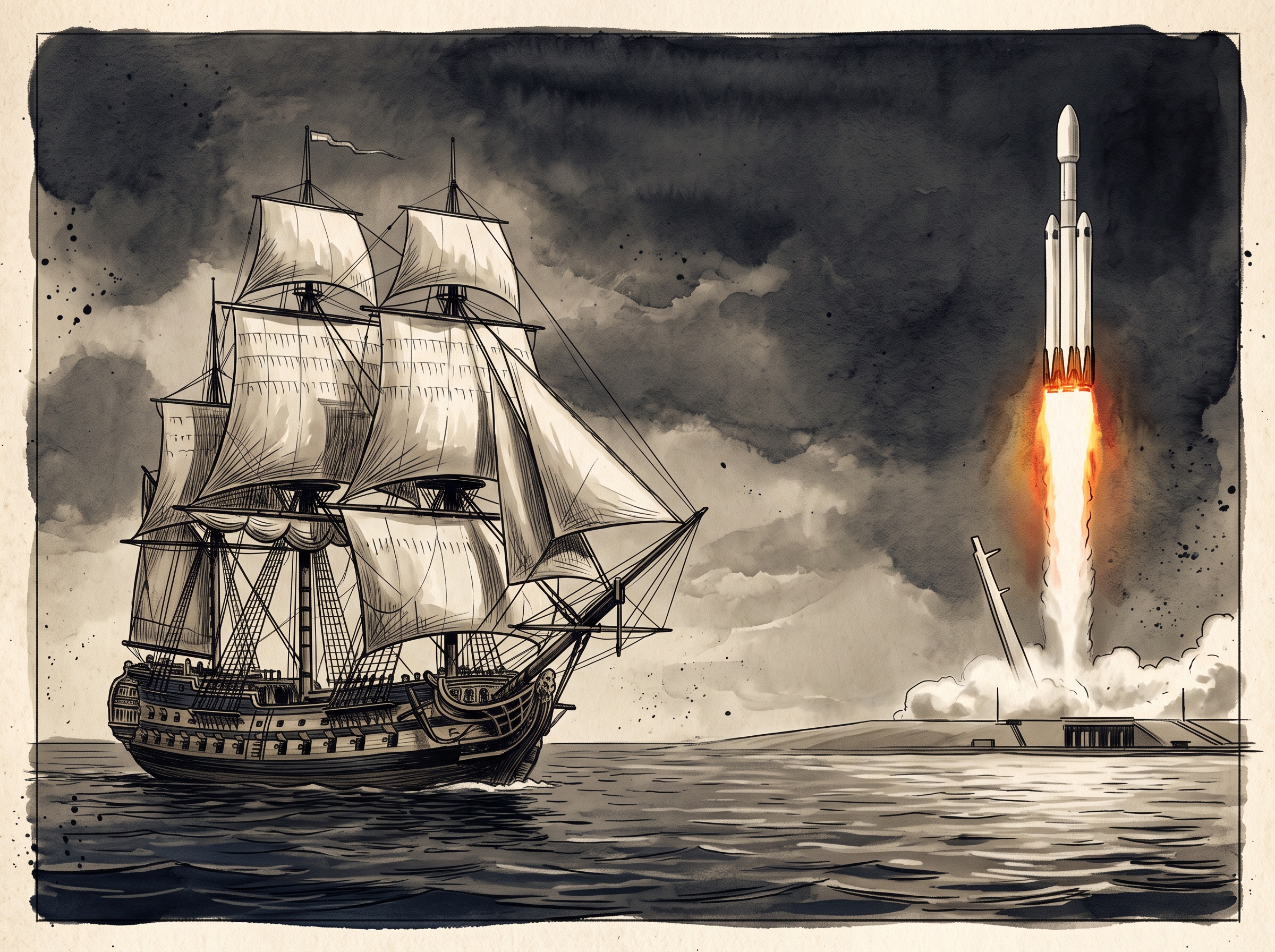
Tao Dong's point was that the valuation isn't the story. The story is the pattern, and we've seen it before. There were three East India Companies: Dutch, French, and the British one we all remember. Each time, a government wanted to open a frontier it had neither the money nor the technology to reach, so it chartered a private company to go instead. The East India Company built the shipping routes, the ports, the trading networks from the Cape of Good Hope to the Strait of Malacca. Private capital, executing national strategy, at a frontier no state could reach alone.
That is SpaceX today. America wants the stars and can't get there on its own, so a private company builds the vertical stack: rockets, Starlink, now AI. The East India Company had its own army and its own currency. Musk has neither, and as Tao Dong put it, he doesn't need them. He has stock.
What struck me wasn't the finance of it. It's what the pattern says about legacy. Enterprises that show up at an open frontier don't just make money. They end up writing chapters of history, and their infrastructure outlives them by centuries. The East India Company's legacy is deeply complicated, and that's part of the lesson too: frontier companies shape the world whether or not the world gets a vote.
Stock-market capitalism
Tao Dong has a name for the system that makes this possible: stock-market capitalism.
The numbers he showed: before 1998, US stock market capitalization averaged about 60% of GDP. From 1998 to 2008, about 127%. Today it stands near 238%. American growth rides on the market. American consumption rides on the market. Tech competition, even national strategy, rides on the market.
His conclusion was blunt: if US equities ever truly crash, you won't be the only one who can't sleep. The White House can't sleep. The Fed can't sleep. The whole system has an overwhelming incentive to keep the flywheel spinning. Liquidity-driven froth will correct, and pockets already have, but underneath it the big companies' free cash flow is real. This is not 1999.
The uncomfortable half of the same idea: a world running on stock-market capitalism splits people into two groups, those who invest and those who don't. He described $7,000 concert tickets selling out while shoppers at the grocery store tighten their belts, both true at once. The K-shape isn't a Chinese phenomenon or an American one. It's the operating system now.
A second Gilded Age
The last time private fortunes and national destiny were this entangled, we called it the Gilded Age. Railroads, steel, oil. Barons whose wealth had no precedent, building infrastructure that outlasted every one of them.
Tao Dong reached for the same era, from a different angle: Credit Suisse and UBS were both born in the 1850s, because the railway revolution needed financing and someone had to invent the institutions to provide it. There was a crash in the 1860s. The railways got built anyway. Technology revolutions are never a straight line, he said, but riding them is still the main way anyone outruns inflation. Not gold, not the usual banker wisdom. Productivity revolutions: AI now, and after it biotech, quantum computing, alternative energy, space technology, new materials, one wave after another.
And the new land grab is already on. Low-earth orbit fits maybe 40,000 to 60,000 satellites in total. China has applied for 200,000 slots, Europe for 190,000. Tao Dong's boldest claim of the day: within ten years, compute lives either on the ground or in orbit, but not both. Solar power in space is free and unlimited if you can launch enough panels, and the US is planning launches at a pace of a rocket every hour. History doesn't repeat, but it's the best lens we have for understanding who we are and what's actually happening around us.
"Forget the past China"
His advice on China was the bluntest line of the afternoon: everyone in this room made money in the old China; if you want to make money in the future China, forget the past China.
The old playbook of demand stimulus and property rescues is over. The policy language has visibly cooled, and he told the room not to hold its breath waiting for a big real estate package. What replaced it is supply-side management, and the new engine has five cylinders:
- A self-improving AI loop. Since DeepSeek, China's models can train their successors. R1 helps build R2, R2 builds R3. The dependence on foreign technology is fading.
- Mature chips at scale. 28nm and 14nm capacity is about to explode. Most of the world's devices, from appliances to aircraft, run on mature nodes, and China is about to make them at cabbage prices. His half-joke: by 2028, will America be sanctioning China over 3nm, or China sanctioning America over 28nm?
- Cloud and data centers, building out at roughly one-eighth of US scale but accelerating on the same curve the US rode in 2023.
- Data. China has the largest consumer data pool on Earth, currently siloed inside platforms. He expects the government to consolidate it within five years.
- Applications. The phase where the money actually gets made, which is the same conclusion the bank's own AI framework reached.
He was equally sharp about what isn't fixed. Deflation, he argued, is not a statistic, it's a mindset: if you believe everything will be cheaper tomorrow, you delay buying; if you believe next year's profits will be worse, you delay investing. A positive PPI print doesn't end that psychology. Debt does, or rather, resolving it does. Exports grew 27% in June, driven by exactly the new industries above, while domestic demand stayed weak. Two Ks: new economy versus old, exports versus home.
Hong Kong's position in this story
And that's why I keep coming back to Hong Kong.
This city's own story began in that same era of trading companies and contested frontiers. Hong Kong became what it is by being the bridge: between East and West, between capital and ideas, between China and everywhere else. That identity was forged by history, and it's still the city's greatest asset.
Tao Dong didn't spare Hong Kong, and I'm glad he didn't. The Hang Seng, he said, has become a platform index, a food-delivery index. The platforms are profitable, but they're standing still on AI, and nowhere else in the world do they carry this much index weight. His fix is structural: tilt hard toward the new economy, pull breakthrough tech companies to list here, and fix the rules that push them to NASDAQ instead. Why must a company show profits to list? Why is approval this hard? A financial center that misses the technology cycle stops being one.
Which sharpens the question I sit with: does Hong Kong settle for being a bridge, or does it grow into a leader? A bridge is a position. Leadership is a choice. The capital is here. The talent is here; I watched 300 builders prove that at SEA Hacks earlier this month. What the frontier eras rewarded, every single time, was the place where builders, capital, and ambition gathered in the same room and understood the moment they were living in.
Builders write the next chapter
Every East India Company started as a small crew willing to sail toward an unclaimed frontier. Every Gilded Age empire started as a few people and a workshop. The frontier is open again — AI, agents, robotics, orbit — and the sharpest economist in that ballroom just told a room of bankers that riding technology revolutions is the main way anyone gets ahead from here.
He said the future divides people into those who invest and those who don't. I'd add a third kind: those who build. That's who I'm betting on.
Hackathons are where crews form. That's why we build them.
If you're building in Hong Kong, reach out. I would love to connect.
Comments
Loading…