Chinat · September 9, 2026
The Case for Founder-Beneficial Public Tools
A positive externality is value created for someone beyond the person or organization paying for it.
Positive externality
Last week, a VC described two tools he wanted for his fund. He asked for a deal-flow graph showing where money is going through the PitchBook API, and a per-lead tracker that could parse incoming decks and email an assessment report.
Those are internal tools. I think that the larger opportunity is public. Build something founders actually use, learn from the work they do in it with their consent, and connect that signal to the fund's private workflow. I have been calling these founder-beneficial public tools: a tool that gives a founder useful feedback or direction, and gives the fund a consented signal as a by-product.
This post is the case for building them, and at the end, an offer to build one with you.
How venture capital has worked
For the longest time, venture capital has been about finding the best deals before everyone else. Partner time limited how many founders a fund could understand closely, so most firms relied on public information, introductions, trusted relationships, and judgment. Large public founder programs stayed the exception, with firms such as a16z and Y Combinator the most visible examples.
Lead magnets for venture capital
For VCs, public writing, events, and educational content are the lead magnets: something useful given away so the right people have a reason to find you. Y Combinator has its YouTube channel and AI Startup School. Both help founders learn and give them a reason to return to YC.
Here is the distinction that matters. Those channels produce audience data: who watched, who applied, who showed up. On their own they rarely produce evidence of how a founder works. Watching a video tells you what someone is interested in. It does not tell you how they make decisions, how they respond to feedback, how they explain a hard idea, or what they build under constraints. Evidence comes from work, and a video does not ask the founder to do any.
The opportunity for founder-beneficial public tools
AI now gives every other fund a way to build something more interactive. A fund can put out a public tool that reviews a pitch, gives office-hours-style feedback, helps a founder think through an application, or points them to a better next step.
The founder receives something useful through the interaction. With clear consent, the fund also gathers signal on what the founder is building and how they think. The value runs both ways. The positive externality is the value that lands on founders the fund never invests in. The consented signal is the value the fund designed the tool to create.
I think that a founder-beneficial public tool should pass a few simple tests:
- It should be free, or close to it. A founder should not pay to be evaluated.
- It should be useful and educational even if the founder never applies to the fund.
- It should return feedback or direction, not just collect another form submission.
- It should gather signal through real work instead of vanity metrics.
- It should clearly explain what information is being collected and how it may be used.
- It should keep people responsible for investment decisions.
Honestly, a tool that quietly collects founder data without giving anything meaningful back is not founder-beneficial. It is just another intake form.
What this looks like today
gstack, the open-source toolkit Garry Tan released this year, is the clearest example. Its office-hours skill pressure-tests an idea the way YC partners do. A founder brings in their work, gets structured feedback, and leaves with a design doc they can use whether or not they ever talk to YC. Then the same tool offers to open the YC application, and the link carries a gstack tag, so YC knows which applicants came through it. Value first, the ask second, and the founder's own work as the signal in between.
gstack office hours, run live in the AI for VCs class on September 3.
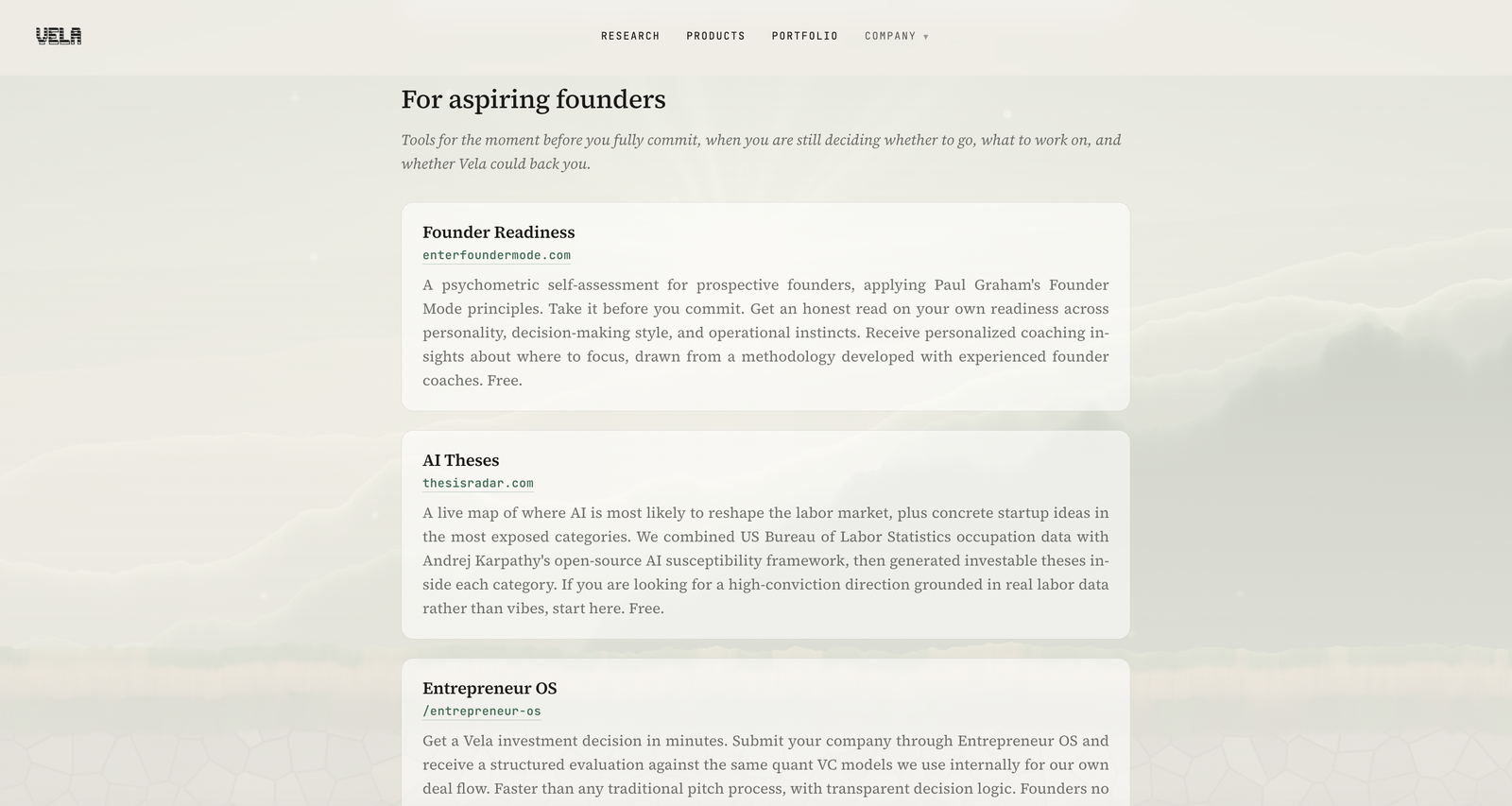
Vela Partners, an AI-native quant fund, keeps a set of free tools for aspiring founders on its products page: Founder Readiness, a self-assessment of whether you are ready to start; AI Theses, a map of where AI is likely to reshape the labor market, with startup ideas in the most exposed categories; and Entrepreneur OS, where a founder submits a company and gets a structured evaluation back. Each one gives a founder a next step before anyone asks for a deck, which is the public half of the model. Whether any of it feeds Vela's own investment process is not something an outsider can see.
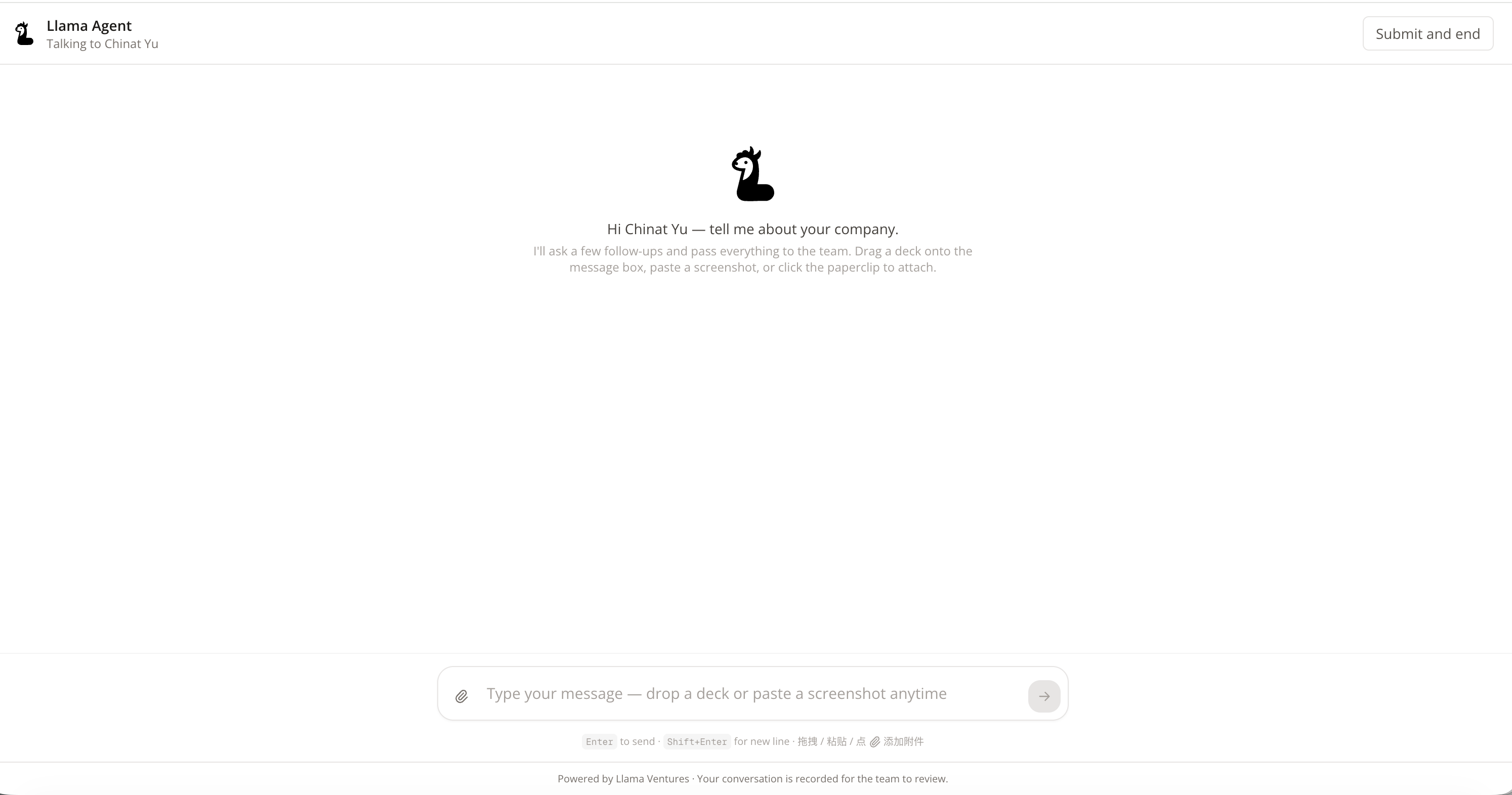
Llama Ventures, an AI-native fund founded in 2024, uses a conversational front door. Instead of a form, a founder meets the Llama Agent: it greets you by name, asks about your company, follows up with a few questions, takes a deck or a screenshot, and passes the conversation to the team to review. It is intake rather than feedback, but it gives the founder a conversation and a human reader instead of a form.
Last week I taught this from the fund side, in an AI for VCs class, as a shift from extractive to attractive and reciprocal. Most funds use AI to extract: parse the deck, score the founder, file the result. The reciprocal version gives something back first, an interview that leaves every applicant real feedback, or office hours anyone can use, and lets the signal arrive as a by-product.
What we built at Stanford
For Stanford Founders Demo Day, we built and used an AI interviewer during the selection process. We started with about 150 applications, and 60 startups presented on May 7, 2026, on a platform with 300+ founder and investor profiles.
Every applicant who took the interview received a report: an overall score and a breakdown across problem clarity, solution viability, market understanding, team strength, and execution readiness. The AI summary did not decide the application. The organizers read the interview alongside the written application, and it gave us context a static form never does: how a founder explains the problem when asked to, and what they do with a follow-up question.
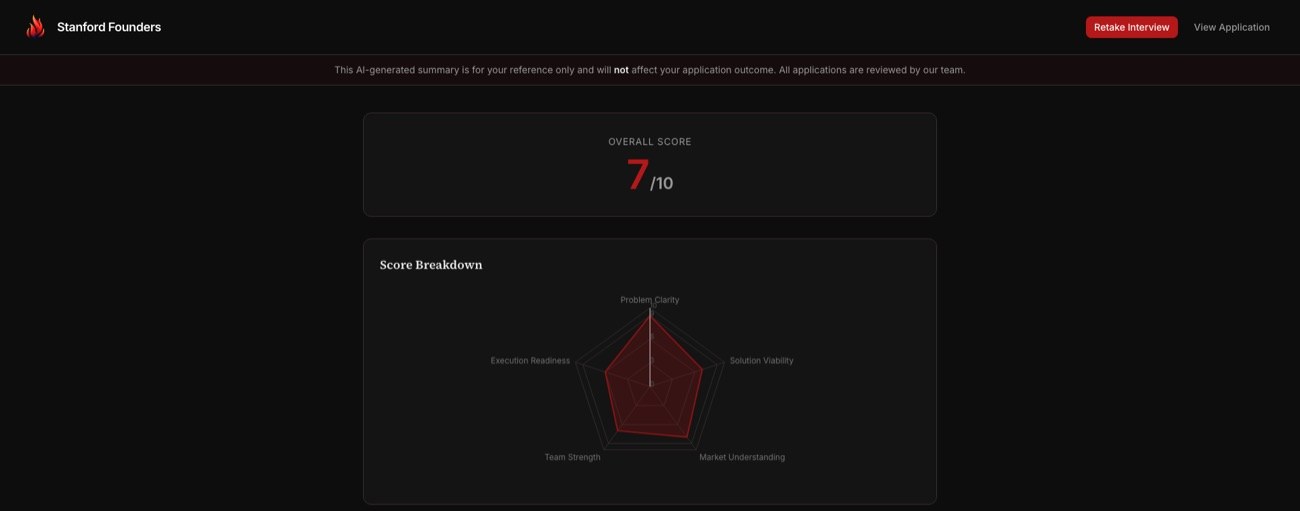
What the founder sees after the interview. The banner at the top says it plainly: the AI summary is for their reference and does not decide the application.
The same platform had an investor side. On Demo Day, investors browsed the cohort, liked and bookmarked teams, requested decks, and ran a practice portfolio. So one platform ran two workflows: applicants received feedback during selection, and investors recorded their interest on Demo Day. Running both in one system shows the infrastructure.
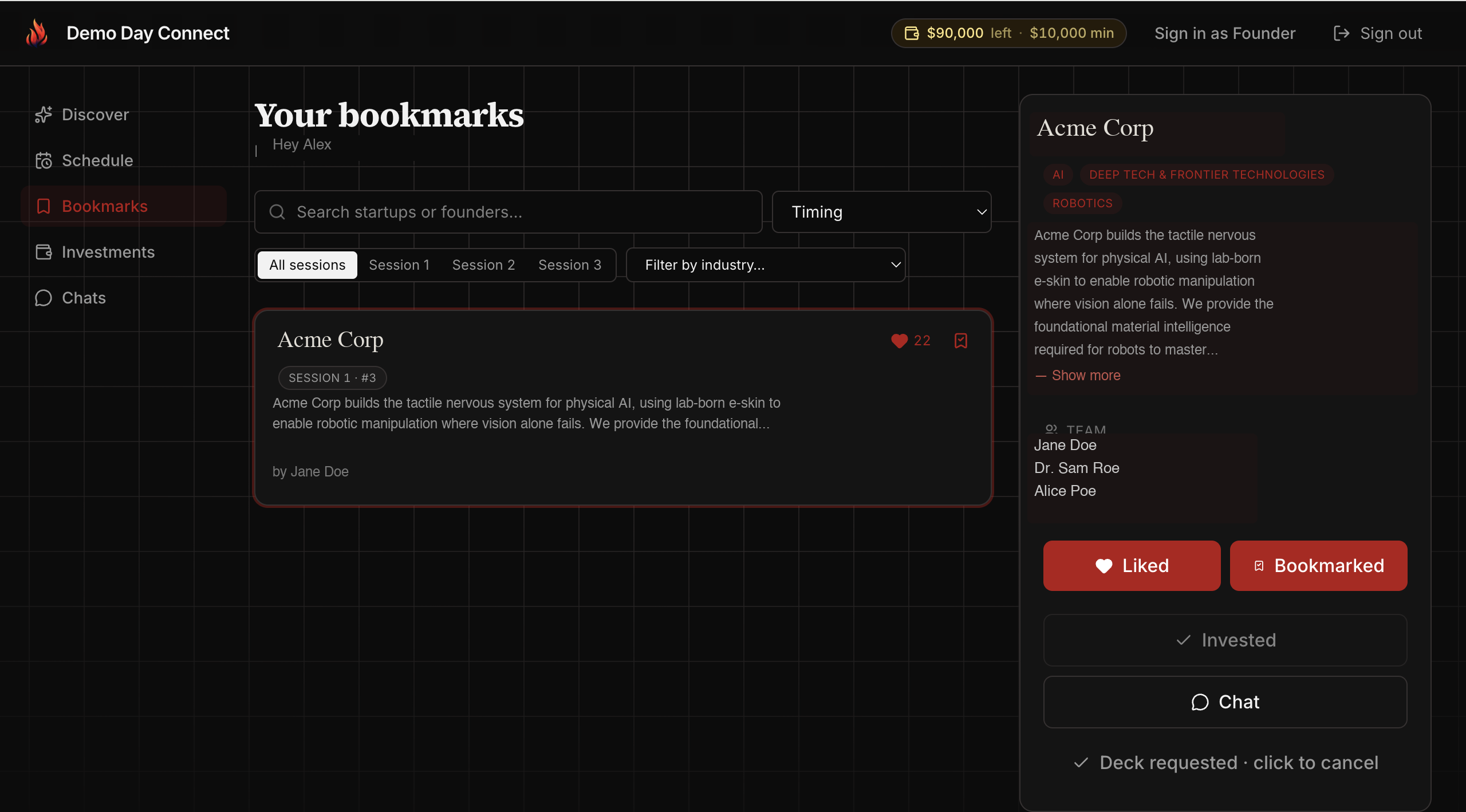
The investor side of the same platform on Demo Day, with names redacted.
What is not proven yet
These examples show the model is buildable. They do not yet show that the signal makes investment decisions better. That is the test worth running: one fund, one public tool, one season of founders, and an honest look at whether the interactions predicted anything the partners did not already know.
Why not just have an associate build a chatbot
The tool is the easy part. The hard part is the loop: consent that founders actually understand, a connection into the systems the fund already uses, a population of builders that keeps producing signal after the tool launches, and a human decision at the end. Through MentorMates we already run hackathons, support builders after the events, and keep the builder signal they produce. Through Stanford Founders we have run both sides of the system in a live selection. A chatbot is a weekend. The loop is the product.
The offer
I am talking to VCs and fund operators about a paid, scoped engagement. In six weeks: one live founder-beneficial public tool with your fund's name on it, built on what we already run, and put in front of the founder communities we run at Stanford and across the Bay Area. Founders' consented signal flows into your existing stack, and your partners keep the final call.
If you run platform or deal flow at a fund, have one founder workflow worth testing, and have budget for a paid six-week pilot, reply, DM me on LinkedIn, or book a call: calendly.com/chinat/personal
Comments
Loading…