Chinat · June 25, 2026
Johns Hopkins Is a 150-Year-Old Startup
Johns Hopkins Is a 150-Year-Old Startup
I went to a birthday party for my university last night and left thinking about runway.
It was the Johns Hopkins sesquicentennial, the 150th, held at a reception in San Francisco with a jazz duo playing in the corner and a tray of crab cakes that everyone there understood to be the point. I graduated from the Whiting School of Engineering in 2023 with a computer science degree, came out to Stanford for a master's, and stayed in the Bay to keep working on the same question I have not been able to put down: what does education actually become in the age of AI. So I was there partly for the crab cakes and partly because I wanted to hear two historians explain how an institution survives a century and a half.
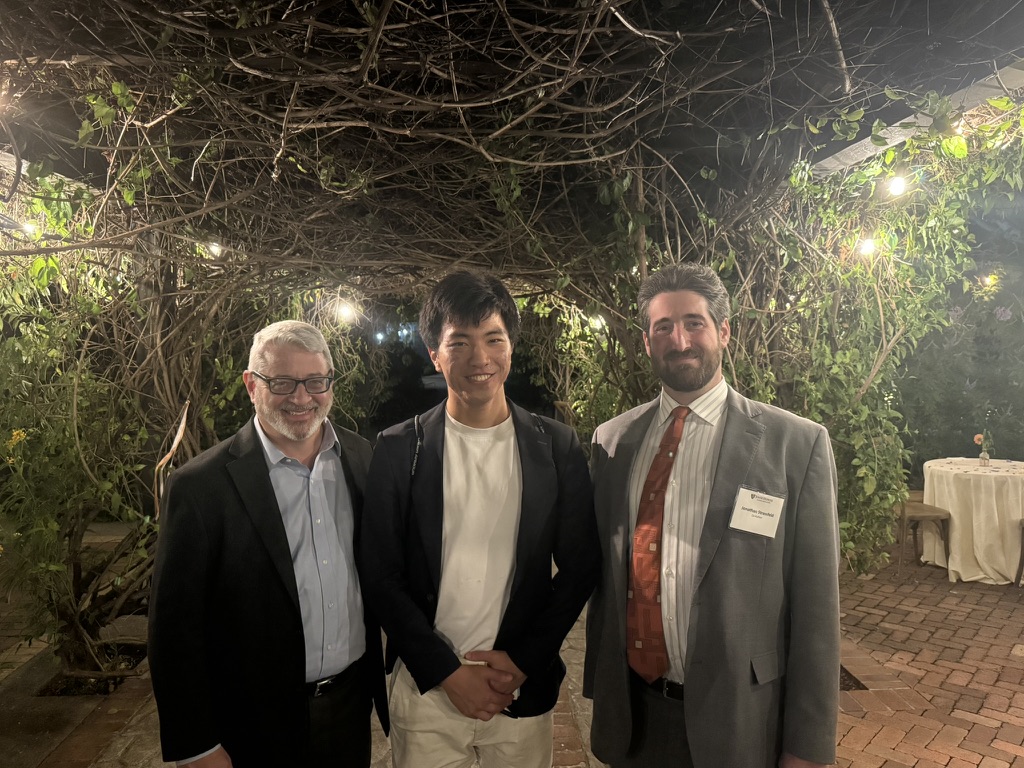
With Andy and Jonathan, the two historians who wrote the book, at the 150th reception. They set out to describe the founding of a research university and ended up describing a startup.
The panel was for a new book, Johns Hopkins: The First 150 Years. The Dean opened, the CEO of Pendulum Therapeutics moderated, and the two authors, Andy and Jonathan, walked the room through the founding. I expected the comfortable version of that story, the one where a great man has a great idea and a marble building appears around it. That is not the story they told.
The story they told is that in 1876 a man named Gilman traveled to Europe to recruit scholars nobody in America could name yet, because the talent he needed did not exist where he was standing. There were twelve undergraduates in the first class. Professors started and ended their courses whenever they felt like it. Students showed up and left at will, and the only thing that counted was whether you could pass the exam at the end of the term. The entire endowment was sitting in railroad stock that kept failing to pay dividends, so the place lurched from funding crisis to funding crisis while trying to invent the modern research university at the same time. One of the authors said it plainly: it sounds like a startup. The room laughed. He was not joking.
That reframing did something to me for the rest of the night. We talk about universities as if they are the most permanent things in the world, ancient stone institutions that have always cared about knowledge and always will. But the social compact that actually funds them, the deal where the federal government pays for research and mostly stays out of what gets taught, is about eighty years old. It started during World War II, when campuses got turned into armories of expertise, and it has been renegotiated and threatened in nearly every decade since. McCarthyism in the fifties. Budget fights over which topics are allowed to be studied. The slow erosion of public trust in higher education over the last ten years, which is not really an ideological problem so much as a pricing one. The compact is not a law of nature. It is a startup's customer contract, and the customer has been getting harder to keep.
When the floor opened for questions, I asked mine. With AI democratizing knowledge and chewing through knowledge work, how should a place like Hopkins balance the vocational job of preparing people for the workforce against the older, slower job of pursuing knowledge for its own sake. The panelists pointed out this is the oldest fight the university has. The faculty in the postwar years fought to keep Hopkins small and theoretical, resisting the business school, nearly rejecting the international studies school for being too vocational, too focused on training diplomats instead of producing knowledge. The tension I asked about is not new. It is load bearing. The institution has been arguing with itself about it for 150 years, and the argument is part of how it stays alone.
The deeper conversation happened after the panel, off the stage, holding drinks. One of the authors turned out to have written about the phenomenological critique of AI, and we got into it. His point, which I have not stopped chewing on, is that computers still do not have bodies. We do not receive the world as clean data. We are spread across an ambiguous situation, thinking through our hands and our feet, where everything carries a personal significance. I cannot touch that because it burns. I want that. That web of meaning is what lets us tell what is real from what is not, and it is exactly what a model does not have. He pointed at Heidegger's old observation that a tool disappears while you use it. You do not feel the hammer, you just hammer, until it breaks and suddenly it is a heavy object in your hand again. His worry, and now mine, is that AI is a tool designed to disappear into your thinking, and we are letting it become invisible before we have decided what it is doing to us.
That is not an abstract worry for me. It is the whole reason I work on what I work on. The thing I keep seeing is a bifurcation. For a strong engineer, AI takes you from one to a hundred. For someone who never built the foundation, it takes you from zero to one and then quietly removes the rung you would have climbed next. The entry-level work that used to go to a junior, the slow grind through a problem that actually teaches you something, gets handed to an agent instead. We are optimizing away the apprenticeship. A lot of my friends who graduated into software engineering two years ago are watching the ladder they climbed get pulled up behind them.
My answer to that, the one I have been building instead of just worrying about, is hackathons. Not as weekend events, but as educational infrastructure. The interesting thing happening right now is that hackathons are migrating from an informal, grassroots learning space into something schools are starting to treat as real pedagogy, a protocol for project-based, entrepreneurial learning that the classroom is bad at. The Dean mentioned, almost in passing, that the renovated library is building a data science and scholarship commons and that hackathons are one of the things they intend to host in it. That is the migration happening in real time. The thing I have been obsessed with for years, my whole thesis, walking into the oldest research university in America through its front door.
Here is what stayed with me. Hopkins survived 150 years not by deciding what it was once and defending it, and not by chasing every market that opened up. It survived by being genuinely willing to reinvent the form while refusing to give up the one commitment underneath it, which is that knowledge is worth pursuing rigorously and sharing generously, even when that is expensive and unpopular. It was a startup that kept its mission and changed almost everything else. That is a much harder trick than it sounds, and most things, companies and people included, get it exactly backwards. They cling to the form and quietly let the mission rot.
I am writing this from the same city where every coffee shop conversation is about whether to start an AI company. The maps have new names on them now. But the thing the 150th actually taught me is older than any of that. The institutions that last are the ones that treat their own form as a draft and their mission as the only fixed point. Hopkins is on its next draft right now, library down to the bones, reopening in 2027. I would like to build things that are still being rewritten in 2176 and still pointed at the same star.
Happy 150th. Here is to 151.
Comments
Loading…