Chinat · June 16, 2026
Nordstrom Was a Failed Prospector
Nordstrom Was a Failed Prospector
I walked into the Klondike Gold Rush National Historical Park the other day because it was raining and the building looked warm. Twenty minutes later I was raising my hand, taking the Junior Ranger pledge from a park ranger from El Paso, getting a numbered badge and a temporary tattoo. The ranger told me, casually, that she had never struck it rich. Nobody who came through that door ever has.
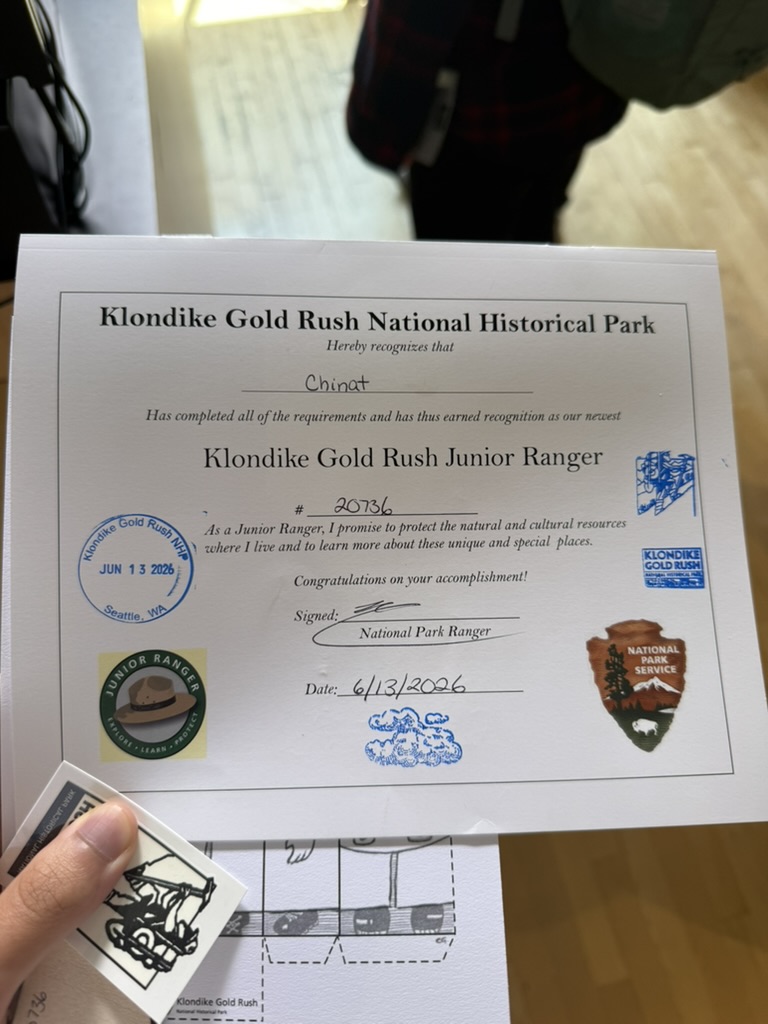
Junior Ranger #20736. Pledged to protect the natural and cultural resources, and to get ice cream after.
That is the whole point of the park, and it took me about an hour to get it.
The Klondike Gold Rush moved roughly a hundred thousand people up through Seattle in 1897 and 1898. About thirty thousand actually made it to the Yukon. Of those, around four thousand found any gold at all. Of those, maybe a few hundred got rich. The rest came home with frostbite and stories.
Meanwhile, two blocks from where I was standing in Pioneer Square, a Swedish kid named John Nordstrom came back from the Klondike with about thirteen thousand dollars and zero interest in ever going back. He put the money into a shoe store with a partner named Carl Wallin. That store became the company that today does around fifteen billion dollars a year and still has his name on the door.
Nordstrom is the famous version of the story: a failed prospector who used his consolation prize to build something much bigger than the dig was ever going to be. It is a great story, but the more I sat in the museum, the more I realized it is not the deepest version of the lesson. Nordstrom still had to go to the river and fail first before he got smart. The people who really understood the rush skipped the dig entirely and went straight to building the infrastructure it needed.
I am writing this from San Francisco, where every coffee shop conversation right now is about whether to start an AI company. Whether to raise a seed. Whether to apply to YC's next batch. Whether the agentic future is real, whether the model layer is commoditized, whether the wrapper is the wedge. Everyone in this city is some flavor of prospector right now. The maps in the 1897 museum had names like Eldorado, Bonanza Creek, Klondike. The 2026 version is GPT, Claude, Gemini, Anthropic, OpenAI. The maps are different. The shape of the crowd is identical. And the survival math for selling tools to AI startups is much better than the survival math for being one.
The part of the park that actually stuck with me, though, was the quieter version of the same story.
The clearest version of it is Belinda Mulrooney. She was in her mid-twenties when she arrived in Dawson City in 1897, carrying a load of goods she had bought in Seattle. She sold them at the kind of markup that only an active rush makes possible, and used the proceeds to build two hotels. By the end of the rush she was one of the wealthiest people in the Yukon, and none of my history textbooks ever mentioned her. She was not an exception, either. A lot of people came out of the Klondike better off than the ones panning the rivers, because they ran the restaurants, the boarding houses, the dance halls, the laundries, the whole social and commercial layer the gold towns actually depended on, and many of them had moved north on the same boats as the prospectors with no intention of ever swinging a pickaxe. Mulrooney did not prospect. She did not fail at prospecting and then pivot. She read the trade correctly from the start, got on the same boat as the rush, and built the building everyone in town ended up needing.
That, I think, is the version that is actually instructive for what is happening in AI right now.
What I have actually been doing for the last two years is hackathons that find the strongest builders, programs that develop them, partnerships that connect them to real customer problems, and a network that bridges the best into Silicon Valley resources they could not otherwise reach. The geographic version of it is the founder pipeline for Hong Kong and Southeast Asia. The structural version of it is an accelerator. The Klondike version of it is the hotel in Pioneer Square, up in Seattle.
Seattle is the part of the Klondike story people forget. No gold was ever found there. Not an ounce. Seattle got rich because it was the hub every prospector launched from, the place the entire northbound rush had to move through to outfit and start the journey, and it kept that money long after the gold ran out. Nordstrom built his base there. Belinda Mulrooney bought the goods she carried north there too, before she ever built a hotel. So did most of the people who actually came out of the rush ahead.
The same shape is forming again now, far bigger than before. Southeast Asia is close to 700 million people, with another 1.4 billion in China right next door, and across the whole region the talent, the capital, and the appetite for AI are all there in abundance. And yet the ambition still points at one place. Everyone serious still wants to get to San Francisco, and the trail there is long and expensive. Immigration is hard and getting harder, and most of that talent has never set foot in the Bay.
AI was supposed to erase all of this. You can ship a serious product out of Jakarta or Manila now without ever booking a flight. But the thing that does not travel over the wire is community: the density of other builders, the people who have done it before, the simple pull of being somewhere that takes the work seriously. That still moves your odds, and it still lives in only a handful of places.
So the real question is how you build one of those places here. Hong Kong is the natural Seattle for this rush. It sits beside the densest concentration of builders on earth, it is the cleanest staging point for founders aiming at the Bay, and it is the obvious door for Westerners heading the other way into the Asian market. A builder from Manila or Shenzhen could land there, find the community and the credibility, and reach the Bay from a running start instead of arriving cold. Get that right and Hong Kong becomes the city that thrives in this rush the way Seattle thrived in the last, not by winning the goldfield but by being the place the whole thing moves through. The Bay is the Yukon. Hong Kong is Seattle.
The thing this takes is not a famous exit or a startup already sold. It is closeness. I have spent two years on this boat with the builders, near enough to see what they need at the moment they need it. You do not have to strike gold yourself to build the thing the whole rush depends on.
The Junior Ranger pledge ended with the line "and to get ice cream after this." We did. And I walked back out into the rain thinking that most of the people on the boats in 1897 did not get rich, that the ones who did were almost never the ones panning rivers, and that the ones who got really rich were the ones who built the hotel in the town the whole rush had to pass through, before anyone else did.
Comments
Loading…